Before a plush toy can be sewn, the fabric has to be spun. Here is a look at the localized raw material networks that keep production lines moving.
Most sourcing conversations start at the factory door — MOQs, lead times, sample rounds. But by the time a roll of fabric reaches the cutting table, it has already passed through a raw material network most buyers never see. Understanding that network is one of the fastest ways to tell a direct manufacturer with real production leverage apart from a broker reselling someone else's inventory.
In this article:
- The Fabric: Where Minky Actually Comes From
- The Filling: PP Cotton and the Petrochemical Link
- The Small Detail That Isn't Small: Embroidery Thread
- Why the Relationship Is the Real Product
- The Eco-Friendly Shift: rPET
- The Takeaway
The Fabric: Where Minky Actually Comes From
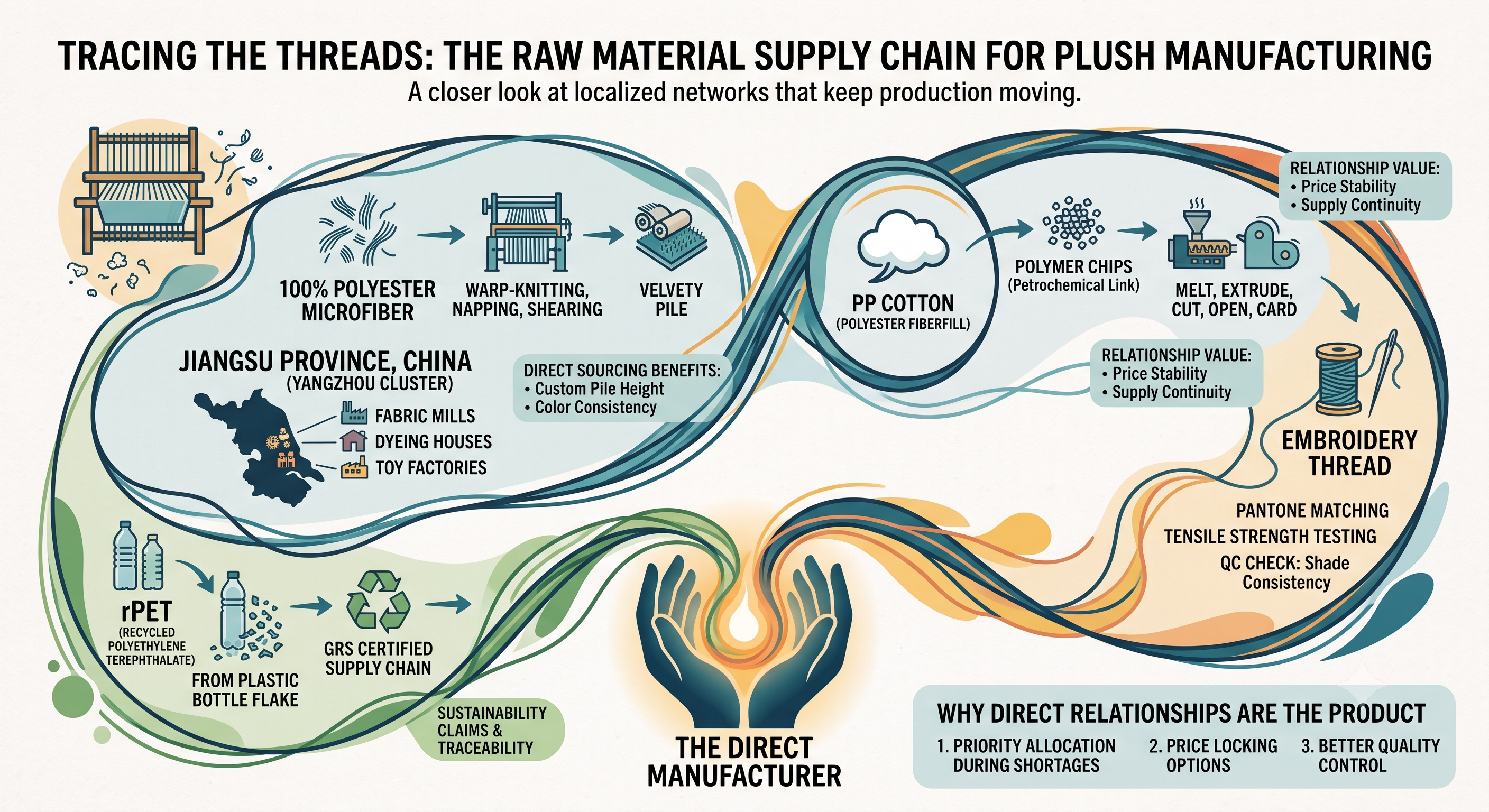
Minky is the fabric most people picture when they think of a plush toy's outer shell — dense, brushed, and soft enough to pass as fur without the fur. It starts as 100% polyester microfiber, knitted on specialized warp-knitting machines into a tight base cloth, then run through napping and shearing processes that raise and trim the fibers into that signature velvety pile.
China produces the overwhelming majority of the world's minky and plush-pile fabric, for a simple reason: it's also where the overwhelming majority of the world's plush toys are made. Jiangsu province is home to some of the densest clusters in this supply chain, most famously around Yangzhou, where fabric mills, dyeing houses, and toy factories sit close enough together that a dye-lot inconsistency can be caught and corrected before it ever reaches a sewing machine. A manufacturer sourcing directly from these mills — rather than through a middleman — can also request custom pile heights and hold colors steady across a large repeat order.
The Filling: PP Cotton and the Petrochemical Link
Inside almost every plush toy is a material the industry calls "PP cotton," a bit of a misnomer since it contains no cotton at all. It's polyester fiberfill, spun from polymer chips that trace back to the petrochemical industry. The resin is melted, extruded into fine filaments, then cut, opened, and carded into the springy, cloud-like fiber that gives a plush toy its shape and squeeze.
Because that raw resin sits at the start of a petrochemical supply chain, its price tends to move with global feedstock costs — which is exactly why long-standing supplier relationships matter here more than almost anywhere else in the bill of materials. A factory with years of purchase history at a fiber mill tends to hear about a price move before it happens, not after.

The Small Detail That Isn't Small: Embroidery Thread
Eyes, noses, brand tags, and stitched-on details all come down to thread, and thread is where a surprising amount of quality control quietly happens. Colors are matched to Pantone references at the design stage, then sourced from specialized thread mills that test each batch for shade consistency and tensile strength before it ships. A shade that drifts half a tone between production runs is barely noticeable on a single toy — and a real problem across a ten-thousand-unit order. It's usually one of the first things an experienced buyer's QC team checks on incoming samples.
Why the Relationship Is the Real Product
None of this is really about any one material. It's about what a direct line to the people who make these materials buys a manufacturer when something goes wrong. When a shortage hits — a fabric mill running behind, a spike in resin pricing — factories with established accounts tend to get priority allocation and the option to lock in pricing through forward agreements. Buyers working through a trading company are usually competing on the open spot market along with everyone else, with far less visibility into why a quote just changed.
The Eco-Friendly Shift: rPET
The newest thread running through this network is a recycled one. rPET (recycled polyethylene terephthalate) starts from the same point as standard polyester fiberfill but swaps virgin resin for cleaned, processed plastic bottle flake. Once spun, it performs almost identically to virgin fiber — comparable softness, durability, and full compliance with international toy safety testing — with a GRS (Global Recycled Standard) certificate to verify where the material actually came from.
Demand for rPET fabric and stuffing has grown fastest among North American and European buyers looking to back their own sustainability claims with a traceable supply chain. Manufacturers with existing direct lines into fiber suppliers are the ones who can add a recycled option to a quote sheet without disrupting the rest of a production run, because the relationship — not just the material — was already in place.
The Takeaway
The next time a quotation lands in your inbox, it's worth asking where the fabric, filling, and thread actually came from. The answer says almost as much about a manufacturer's reliability as any certificate on their website.